
At least two key legislative changes upcoming
A couple great Delaware Republicans are throwing in the towel and not returning, making the 2026 election extremely important.

A tenuous gap between being a bulwark for sanity and total irrelevance currently exists in the Delaware General Assembly. Under state law, a 2/3 majority is required to pass amendments to the state Constitution, which must be passed in two consecutive legislative sessions. (In layman’s terms, to pass a state Constitutional amendment with its first leg voted on in the 2025-26 term, it has to face a second passing vote - the “second leg” - in the 2027-28 session. Uniquely in Delaware, aside from electing the representatives, voters have no say in the matter.)
Because Democrats have a 15-6 advantage in the State Senate, they can lose one voter and still pass said amendments because they only need 14 votes. On the other hand, the Republicans united can still stop this madness in the House because they have 14 votes out of 41. Democrats dream of getting that 28th House vote in order to run roughshod over our liberties and turn us into Delifornia in a matter of just a few years.
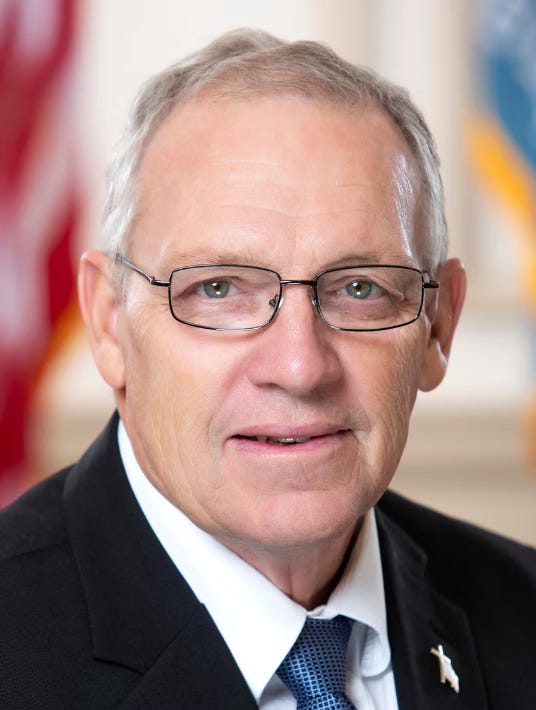
The task for Republicans will now get a little harder as two veteran pols will step aside for younger blood in the next election. First it was Rep. Rich Collins of the 41st District who stated he would not seek another term, then Rep. Charles Postles of the 33rd District followed suit with his announcement the next day. In his statement, Postles revealed some recent health issues prompted the decision.
At this point, both a Republican and a Democrat have filed for the 41st District seat as Douglas Conaway is the first to come out for the GOP while Ryan Stuckey represents the Democrat ticket. In the 33rd, there is a Republican hopeful by the name of Matt Bucher who has filed and is being challenged by previous candidate Morgan Hudson in the Republican primary. Hudson ran against Postles and one other opponent in 2016 when the seat was last open.
In the coming months I’ll be looking deeper into these races, since the only statewide races for state offices in 2026 will be for Attorney General, State Auditor, and State Treasurer. (On Thursday, current Treasurer Colleen Davis announced she would not seek another term, which opens up that race. You may recall she dropped out of the race for Congress in 2024 due to health issues.)
We will also have two of our Three Stooges on the ballot: Rep. Tim Sarah McBride and Sen. Chris Coons. Worth noting: the only federal candidates from the GOP side so far with active candidate accounts at the FEC are unsuccessful 2024 candidate Donyale Hall and perennial hopeful Lee Murphy. If someone else wants to get going, it better happen fast. (Announced earlier this week after the initial draft: Coons will have a primary challenger in Christopher Beardsley, a 32-year-old former Americorps member and Peace Corps volunteer who will be running to the left of Coons.)
Otherwise, Sussex County is leading in filings right now as several of the state legislative seats already have incumbents or hopefuls who have filed, including a primary on the Democrat side in the 20th House District thanks to the special election that put Alonna Berry in office. She’s challenged by one of the others who sought the nomination, Ruby Keeler Schaeffer. Republican State Senator Gerald Hocker (Senate District 20) has already filed, as has Democrat Claire Snyder-Hall of the 14th House District.
Other challengers to the incumbent Sussex legislators are Republican Dr. Nikki Miller, who is hoping for a rematch in House District 20, as well as Democrats Stuckey, Gregg Lindner in House District 4, and Maureen Madden in House District 38. It’s currently presumed in the latter two cases that incumbent Reps. Jeff Hilovsky and Ronald Gray, respectively, will run again.
On a micro level, there will be a number of school board seats up for grabs next spring as the final transition between five- and four-year terms takes hold, meaning those who won in both 2021 and 2022 will be up for re-election for a four-year term through the 2030 election. Also, my local school district here in Laurel will be putting a property tax levy on the ballot in February, perhaps hoping the tiny turnout (voters for this election need only provide proof of residence in the district, not necessarily be registered voters) will guarantee success. (We’ll probably have to outvote their entire graduating class and eligible juniors, plus staff and others who work there.) Considering the school district raped our property for an extra $117 a year thanks to the increase they were allowed via reassessment, good luck with that. (The county’s share was less by a few dollars, but overall my taxes increased almost 10 percent thanks to the court settlement.)
Stick close as I start talking more about the 2026 election after the first of the year.
In the meantime, though, you can Buy Me a Coffee, since I have a page there.