
Out of bounds
Government has run amok, as these two recent examples show.

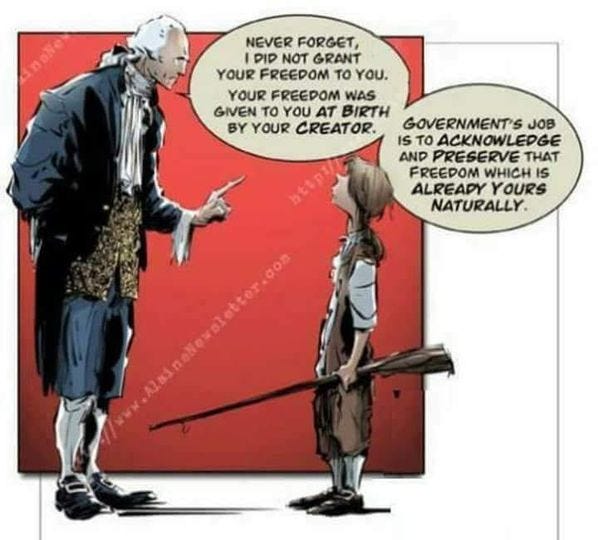
Normally I share fellow Substacker articles on MER with a few comments, but two recent posts have piqued my interest enough to give me a desire to extend my remarks beyond that small scope.
As most of you know, I live in Delaware, which as far as Presidential elections go has been a “blue” state since 1992 and has been a Democrat trifecta since 2008, when the State House switched parties after a long period of GOP control. (Mind you, the Delaware GOP is rather centrist as it is in most Northeast states. We ain’t Oklahoma - or Arkansas, as I’ll get to momentarily.)
Because of that, the aim of the opposition is simply to try and stop bad bills from making the situation worse or using the power in limited instances such as the one I pointed out last Saturday when the Delaware House GOP used its leverage of blocking the capital budget to extract a few concessions from the majority Democrats.
I’m also a native of Ohio, which has been a GOP-dominated state over the last 30 years or so - basically once Big Labor was neutered by the flow of manufacturing overseas, leaving the Democrats with an insufficient base. Yet I moved out of Ohio because the situation wasn’t getting any better - their state GOP favored only the most milquetoast, “electable” candidates so government grew just about as fast as it would have under the Democrats.
I brought up Arkansas because Jack Sotallaro took a break from talking about how Congress is doing us wrong to the situation in his home state.

Here’s the first paragraph premise:
If Republican governance actually restores constitutional limits—if all the speeches about restraint, federalism, and enumerated powers mean anything at all—then Arkansas, with unified Republican control, should be the place where the theory becomes reality.
It should be smaller, tighter, more disciplined. It should look different.
It doesn’t.
Back in the day of Bill Clinton, Arkansas was an old-school Solid South Democrat state. But over 30 years, the state turned Republican so hard that now you can barely find a Democrat. Yet, as Sotallaro complains, things aren’t really that different with the role of government - it’s just that the grift goes to the other party.
Put it all together and you get a situation not unlike the bluest of blue states.
Under unified Republican control, Arkansas maintains a large spending footprint, depends heavily on federal inflows, uses incentives to steer economic outcomes, and relies on executive authority as its primary instrument of governance. What it does not do is meaningfully contract the scope of government.
That absence is the argument.
Because if a Republican supermajority cannot—or will not—produce structural restraint, then the explanation cannot be reduced to Democratic opposition. The constraint is not partisan. It is systemic. The incentives embedded within the current framework reward expansion, reward discretion, and reward control, regardless of which party holds power.
This is where the term “uniparty” stops being a slogan and starts becoming a description.
Yet in situations where government is divided or close to being so, the inertia has a similar effect, with the first casualty being required oversight. Let’s consider what Frederick R Smith has to say about the federal government.

When Congress authorizes a program and appropriates money for it, it accepts a corresponding obligation: to design that program with adequate safeguards, to fund its oversight adequately, and to monitor whether the money is being used as intended. On all three counts, Congress has chronically failed.
Over the last year or so, we have found out that the waste and fraud we feared from the federal government is really occurring, in spades. Quality Learing Center, anyone? Although they were investigated by the state of Minnesota for fraud, that money didn’t originate in Minnesota.
A staggering $9 billion may have been stolen in Minnesota’s sprawling social-services scam orchestrated mainly by members of its Somali community — a figure nearly equivalent to the entire economy of Somalia.
The enormous new estimate is a nearly nine-fold increase from the swiped $1 billion previously suspected, according to federal prosecutors.
It also accounts for roughly half of the $18 billion in total federal funds provided to the Minnesota-run services since 2018, the feds said — as Democratic Gov. Tim Walz continues to take heat for his handling of the debacle.
Frederick then goes into a value argument I’ve also made:
The United States does not tax and spend in a simple loop. When Congress authorizes enormous emergency expenditures—as it did repeatedly during the pandemic—and when those expenditures are not fully offset by tax revenue, the difference is financed by issuing new debt. That debt is purchased, in significant part, by the Federal Reserve, which creates the money to buy it. This is the mechanism by which government spending that exceeds revenue expands the money supply. More dollars chase the same quantity of goods. Prices rise. Every American pays a hidden tax in the form of inflation.
Fraud makes this dynamic worse in a specific and underappreciated way. When legitimate government spending reaches its intended recipients, it typically flows back into the productive economy: a family uses a childcare subsidy to pay a real provider, who pays real employees, who buy real goods and services. The multiplier effect, while debated in its magnitude, at least involves economic activity. But when hundreds of millions of dollars are stolen through ghost daycares, fake meal sites, and fraudulent Medicaid billing, those dollars do not flow into productive economic activity. They flow into luxury goods, overseas real estate, and accounts beyond the reach of American law. The money supply was expanded—the inflationary pressure was created—but no corresponding productive value was added to the economy.
For example, at my “real” job I create value by assisting people who want to improve property by building on it or remodeling what’s there. A few recent examples are converting a vacant shop into a tire store, a former fraternal organization building into a nightclub, and an abandoned restaurant into a nail salon, expanding a local entrepreneur’s business. We also have assisted investors in building new multi-family housing units and developed a parcel for single-family housing, among many other things. This private investment adds value, unlike the so-called “investment” of government funds, which is often just redistribution of wealth.
I’m of the belief that most government activity adds little or no value. Set aside the fraud for a moment and think of all the roadblocks and red tape that are encountered when you want to do something productive, embodied in the actions of government employees who are all about flaunting their power. (As one example, on a rural project we did for a gun range a few years ago the state made them put turn lanes on a road that might carry 500 cars a day.)
Meanwhile our federal government always wants its cut in taxes or fees, to the point that W-2 wage-earners like me pay the government before the check ever hits our bank account. But when people spend someone else’s money, they care neither about cost nor quality. The situation is ever-so-slightly better at the state level, and maybe a pinch improved at the local one, but it’s not like doing business with your neighbor.
The point is that we’re not going to do a whole lot better with the red team than the blue team. What we need is an American team who understands what George up there is saying about the true role of government - hint: it’s not about spending money or redistributing wealth.
In the meantime, though, you can Buy Me a Coffee, since I have a page there.
Thank you. I typically write about the "shiny thing" I see at the moment. I appreciate your support and readership. More and more it seems like "new boss, same as the old boss" is still true.